

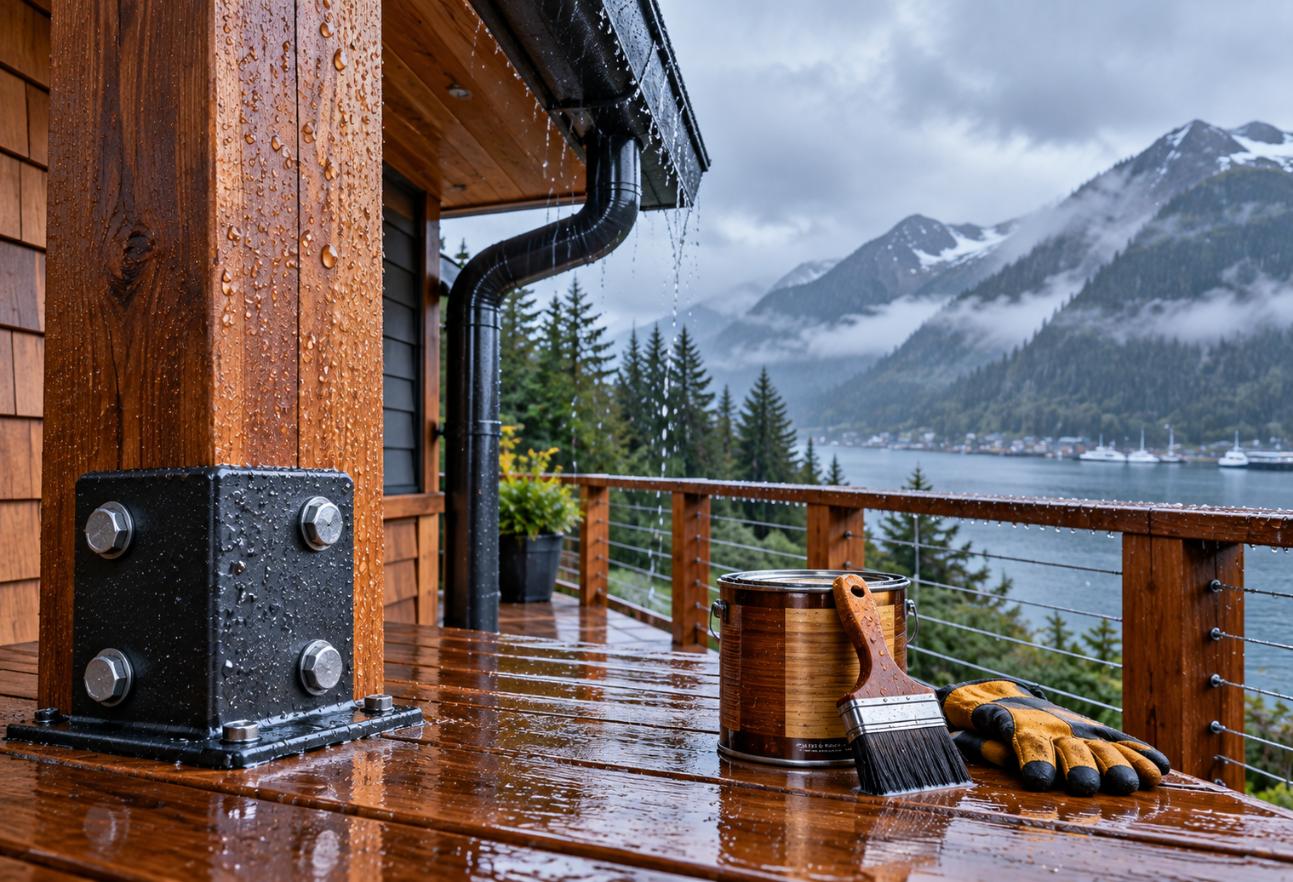
Rain is not an occasional maintenance concern in Juneau, AK. It is part of owning a home, cabin, boat, or waterfront property in Southeast Alaska. Deck boards, stairs, railings, docks, sheds, and exposed hardware all face persistent moisture that can shorten their useful life when routine protection gets overlooked.
Quick answer: Preparing exterior wood and hardware for Southeast Alaska rain starts with keeping surfaces clean, allowing wood to dry before applying a compatible exterior finish, sealing vulnerable end grain and joints, and inspecting metal fasteners for corrosion. Regular checks are especially valuable before the wetter late-summer and fall season arrives.
What local readers should know
-
Exterior wood needs adequate drying time before stain, sealer, or another protective finish is applied.
-
Juneau’s frequent precipitation makes choosing a workable weather window an important part of surface preparation.
-
Hardware near saltwater, including around Gastineau Channel and Douglas Island, deserves regular corrosion checks.
-
Trapped debris and standing water can keep wood wet longer and accelerate deterioration.
-
Spring and early summer can offer useful opportunities to inspect and maintain outdoor wood before wetter fall conditions.
Why Does Exterior Wood Preparation Matter So Much in Southeast Alaska?
Exterior wood preparation matters in Southeast Alaska because the region combines frequent precipitation, high humidity, cool temperatures, and marine influences that can keep outdoor materials damp. The goal is not simply to make a deck or railing look better. Good preparation helps coatings perform properly and reduces prolonged moisture exposure.
Juneau sits within the Tongass National Forest region, part of a coastal temperate rainforest shaped by moisture from the Pacific and steep coastal terrain. From downtown and Douglas to Lemon Creek, Mendenhall Valley, Auke Bay, and properties near Gastineau Channel, outdoor wood regularly encounters conditions very different from those in a dry inland climate.
At Western Auto Marine, we understand that outdoor maintenance here has to account for Southeast Alaska conditions. We help local customers find supplies suited to projects where moisture exposure is an everyday reality.
What Does Local Climate Data Tell Us About Rain Exposure?
Local climate information confirms that Southeast Alaska is an exceptionally wet environment, so exterior maintenance needs to account for frequent moisture rather than occasional storms. The National Weather Service describes Southeast Alaska as a mid-latitude rainforest where ocean moisture and mountainous terrain contribute to frequent precipitation.
The U.S. Forest Service likewise identifies the Tongass as a temperate rainforest with a maritime climate and high regional precipitation. Rain falls throughout the year, while stronger storm systems are particularly common during fall.
That makes timing important. A dry-looking afternoon does not necessarily mean damp wood is ready for a finish. Product directions for surface dryness, temperature, preparation, and curing should always guide the job.
How Does Persistent Rain Affect Wood and Hardware?
Persistent rain affects wood and hardware by repeatedly introducing moisture into exposed surfaces, joints, fastener holes, and damaged coatings. Over time, that exposure can contribute to swelling, checking, discoloration, coating failure, decay, and corrosion, particularly where water cannot drain or surfaces remain shaded.
Hardware deserves equal attention. Screws, bolts, hinges, brackets, latches, and connectors can deteriorate when their protective coating fails. Coastal exposure can add another challenge around docks, boats, waterfront structures, and properties exposed to marine air.
The combination makes routine inspection more useful than waiting until a railing feels loose or a board becomes visibly damaged.
What Warning Signs Should Juneau Property Owners Watch For?
Warning signs on exterior wood and hardware include coating failure, persistent dampness, softness, discoloration, and visible corrosion. Catching these conditions early gives Juneau property owners an opportunity to determine whether cleaning and maintenance are sufficient or whether damaged components need closer evaluation.
Watch for:
-
Peeling, flaking, or worn stain and protective coatings
-
Wood that remains damp long after surrounding surfaces dry
-
Soft or crumbling areas around board ends and fasteners
-
Green or dark surface growth and staining
-
Rust streaks beneath screws, bolts, hinges, or brackets
-
Loose fasteners or hardware pulling away from the wood
-
Cracks that collect water
-
Standing water where boards, stairs, or structural components meet
Pay particular attention to shaded areas and locations beneath vegetation where airflow and drying may be limited.
What Are the Most Common Local Causes of Exterior Deterioration?
The most common local causes of exterior deterioration are prolonged moisture, poor drainage, failed coatings, exposed wood fibers, and corrosion-prone hardware. Around Juneau, those problems are amplified by a cool maritime climate that can make drying slower than property owners might expect.
1. Repeated wetting: Frequent rain keeps surfaces cycling between wet and partially dry conditions.
2. Trapped moisture: Leaves, needles, dirt, and organic debris can hold water against decks and stairs.
3. Failed finishes: Worn or peeling coatings leave more wood exposed.
4. Vulnerable joints and end grain: Board ends, cuts, cracks, and fastener penetrations can be particularly susceptible to moisture entry.
5. Marine exposure: Hardware around Auke Bay, Douglas Island, Gastineau Channel, and other coastal settings may face added corrosion pressure.
How Should Exterior Wood Be Prepared Before Wet Weather?
Exterior wood should be prepared by inspecting it, cleaning away contamination, addressing damaged areas, allowing it to dry thoroughly, and applying an appropriate protective product according to its instructions. In Juneau, planning around weather conditions is just as important as selecting the stain or sealer itself.
Start by removing leaves, needles, dirt, algae, and loose coating material. Check boards and structural components for softness or deterioration before covering them with a new finish.
Allow cleaned wood enough time to dry. Do not assume the surface is ready simply because it feels dry to the touch. Follow the moisture, temperature, application, and cure requirements provided by the coating manufacturer.
Finally, pay attention to edges, board ends, joints, and penetrations where water tends to linger.
How Should Exterior Hardware Be Prepared for Southeast Alaska Rain?
Exterior hardware should be prepared by checking for rust, damaged protective coatings, loose connections, and compatibility with its environment. Hardware that repeatedly encounters rain or marine conditions needs more attention than fasteners protected inside a dry structure.
Light surface contamination may be cleanable, depending on the component. Severely corroded, weakened, or structurally important hardware may require replacement rather than cosmetic treatment.
For new projects, choose fasteners and connectors that are appropriate for the wood, application, and exposure level. Avoid casually mixing metals because incompatible materials can contribute to corrosion. Structural connectors should also match the specifications required for the project.
What Mistakes Can Shorten the Life of Outdoor Wood?
The biggest maintenance mistakes involve trapping moisture, coating damp surfaces, overlooking hardware, and treating cosmetic damage as the entire problem. Southeast Alaska’s climate leaves less room for shortcuts because another stretch of wet weather may arrive before a poorly prepared coating has performed as intended.
Mistake: Applying finish to wood that has not dried sufficiently.
Consequence: Poor adhesion or premature coating problems.
Better approach: Follow the product’s preparation and moisture requirements.
Mistake: Coating over dirt or failing finish.
Consequence: The new layer may bond to contamination rather than sound wood.
Better approach: Clean and prepare the substrate first.
Mistake: Ignoring rusted fasteners.
Consequence: Corrosion may continue beneath the finished surface.
Better approach: Inspect hardware while the surrounding wood is accessible.
Mistake: Waiting until fall storms are underway.
Consequence: Suitable preparation and curing windows can become harder to find.
Better approach: Inspect outdoor projects earlier in the season.
What Is a Common Juneau Maintenance Scenario?
A common Juneau maintenance scenario is a deck or exterior stairway that looks acceptable from a distance but shows wear along board ends, shaded sections, fastener locations, and horizontal surfaces. After repeated wet seasons, some areas may remain damp longer or show more coating deterioration than exposed sections.
The right response is not automatically to cover everything with another coat. Cleaning, inspection, adequate drying, and evaluation of questionable boards or hardware should come first. That preparation helps determine whether the project is routine maintenance or requires repairs before refinishing.
When Should You Call a Professional?
Professional help is appropriate when exterior wood shows structural deterioration, railings or stairs feel unstable, major connectors are corroded, or the project involves components whose failure could create a safety hazard. Homeowners can monitor surfaces and perform routine maintenance, but structural uncertainty deserves qualified evaluation.
That distinction matters on elevated decks, exterior stairs, dock structures, and waterfront properties where damaged wood or hardware can involve more than appearance.
For routine preparation and maintenance supplies, our team can help you explore products for your project and local exposure conditions.
How Do DIY Maintenance and Professional Repair Compare?
DIY maintenance is best suited to routine cleaning, inspection, surface preparation, and protective finishing when the wood and hardware remain sound. Professional evaluation becomes the better option when deterioration involves structural components, extensive rot, questionable connections, or repairs beyond the owner’s experience.
The important step is recognizing the difference. A worn finish on a sound deck board is a maintenance problem. A soft stair tread, unstable railing, or heavily corroded structural connector can represent a repair issue.
Where Do These Maintenance Concerns Apply Around Juneau?
These maintenance concerns apply throughout Juneau and nearby Southeast Alaska communities where outdoor structures experience persistent moisture and marine conditions. Properties in Douglas, Lemon Creek, Mendenhall Valley, and Auke Bay can all benefit from regular exterior inspections.
Conditions vary by exposure, shade, elevation, proximity to saltwater, drainage, and the design of the structure, so maintenance needs will not be identical from one property to another.
What Can Happen If Exterior Maintenance Is Delayed?
Delayed exterior maintenance can allow small coating, drainage, wood, or corrosion problems to become more involved repairs. In Juneau’s wet environment, an exposed board end or deteriorating fastener does not get the benefit of a reliably long dry season.
Routine inspection gives property owners a chance to address manageable maintenance before deterioration becomes more extensive. It can also reveal drainage or debris problems that are relatively simple to correct.
FAQ
How often should I inspect exterior wood in Juneau?
Exterior wood in Juneau should be inspected at least as part of regular seasonal maintenance and after periods of severe weather. Look closely at horizontal surfaces, board ends, stairs, railings, fastener locations, and shaded areas. The condition of the existing finish and the manufacturer’s maintenance guidance should determine when recoating is needed.
What is the best time to maintain a deck in Juneau?
The best time is a period that meets the temperature, dryness, and curing requirements of the products you plan to use. National Weather Service information identifies spring and early summer as Juneau’s comparatively drier season, making advance planning worthwhile before precipitation becomes more frequent later in summer and fall.
Can I stain wood shortly after it rains?
You should not stain wood until it meets the coating manufacturer’s dryness requirements. Surface appearance alone is not a reliable indicator. In Southeast Alaska’s cool, humid environment, wood can retain moisture after rainfall, particularly in shaded locations, joints, and areas with limited airflow.
Does saltwater exposure matter for exterior hardware around Auke Bay?
Yes. Hardware used around marine environments should be selected with its exposure conditions in mind. Around Auke Bay and other waterfront locations, consider both frequent moisture and marine exposure when choosing fasteners, hinges, brackets, and connectors. Follow manufacturer specifications and project requirements rather than selecting hardware based on appearance alone.
Should I cover damaged wood with a fresh coat of sealer?
No. A fresh coating should not be used to hide deterioration. Soft, rotten, badly cracked, or structurally questionable wood needs evaluation before refinishing. Protective coatings work best as part of maintenance on properly prepared, serviceable material, not as a substitute for necessary repair.
Why does my Douglas Island deck stay wet so long?
Shade, limited airflow, debris accumulation, surface orientation, and frequent regional precipitation can all keep a Douglas Island deck damp. Check whether leaves or needles are trapping moisture and whether water drains freely. Persistent softness, deterioration, or structural concerns warrant closer evaluation rather than simply applying another coating.
Is rust on outdoor screws just cosmetic?
Not always. Light surface discoloration and serious corrosion are different conditions, and it can be difficult to judge remaining fastener strength visually. If screws, bolts, brackets, or structural connectors are heavily corroded, loose, or deteriorating, replacement or professional evaluation may be appropriate.
How can I prepare exterior wood before Southeast Alaska’s wetter season?
Start with an inspection, remove debris and contamination, identify damaged wood or hardware, and plan cleaning and finishing around a suitable dry-weather window. Give the wood adequate drying time and follow the selected product’s application requirements. Earlier preparation can provide more flexibility than waiting for persistent fall rain.
Protect Outdoor Wood Before the Next Wet Stretch
Southeast Alaska weather is demanding on decks, stairs, railings, sheds, docks, and exterior hardware, but consistent preparation can help owners stay ahead of avoidable deterioration. At Western Auto Marine, we can help local customers explore the supplies they need to tackle outdoor maintenance with Juneau’s wet climate in mind.
Get Your Juneau Exterior Project Ready for the Rain
Prepare with products selected for the material, application, and exposure your project faces.